Sonatype IQ Server 207 – 207.1 Release Notes
The IQ 207.x release line includes multiple changes to our IQ-powered solutions. View the details in each solution’s section below.
Check Known Issues Before Upgrading
This version line contains known issues
Before upgrading, see the Known Issues & Upgrade Guidance section to determine whether any known issues or upgrade recommendations apply to your environment.
What's New and Noteworthy in IQ Server 207.1?
Released September 9, 2026
Bug Fixes
Issue ID | Description |
|---|---|
CLM-50129 | Policy evaluation completes successfully after upgrade using an existing embedded H2 database, with the database schema migration now leaving all tables in a fully compatible state. |
CLM-50081 | Sonatype Lifecycle now stores only the SAML authentication request details required for response validation, preventing oversized |
CLM-46061 | Policy evaluation now completes successfully for applications containing components with incomplete Maven coordinates, and affected reports remain accessible in the UI. |
CLM-39841 | Claimed component |
What's New and Noteworthy in IQ Server 207?
Released September 3, 2026
 Improvements Impacting Multiple Solutions
This release includes the following improvements that impact multiple IQ Server-powered solutions:
Improved User Token Authentication Performance
Sonatype IQ now uses a more efficient hashing method for server-generated user tokens, significantly reducing the processing time and memory required to authenticate API requests that use user tokens. This improvement is especially beneficial for high-volume environments, helping reduce latency and resource consumption during request surges.
Existing user tokens remain fully supported. When a user successfully authenticates with a token stored using a legacy hashing format, Sonatype IQ automatically updates the stored hash to the new format. No database migration or user action is required.
 Sonatype Lifecycle
This release includes the following changes for Sonatype Lifecycle:
Expanded Yarn Berry Workspace Dependency Coverage
Sonatype Lifecycle now provides complete transitive dependency coverage for Yarn Berry v2, v3, and v4 workspace monorepos during manifest-based analysis. Lifecycle builds the dependency graph from yarn.lock, providing comprehensive visibility into third-party components whether your project uses Plug'n'Play (PnP) or the node_modules install mode.
With this expanded coverage, teams can identify security and policy risks in transitive dependencies that previous scans might not have detected. As a result, Yarn Berry workspace scans might report more components and associated policy violations than earlier analyses; this increase reflects improved dependency visibility rather than duplicate component reporting.
Mythos Readiness Dashboard Enhancements
The Mythos Readiness Enterprise Reporting dashboard now includes new KPI summary cards and visualizations that make it easier to assess component readiness across your applications. Teams can quickly review total applications and components, Golden Fix availability, End-of-Life exposure, and components marked as Mythos Affected, while new Components by Format and Component End-of-Life Status charts provide additional context for prioritizing review.
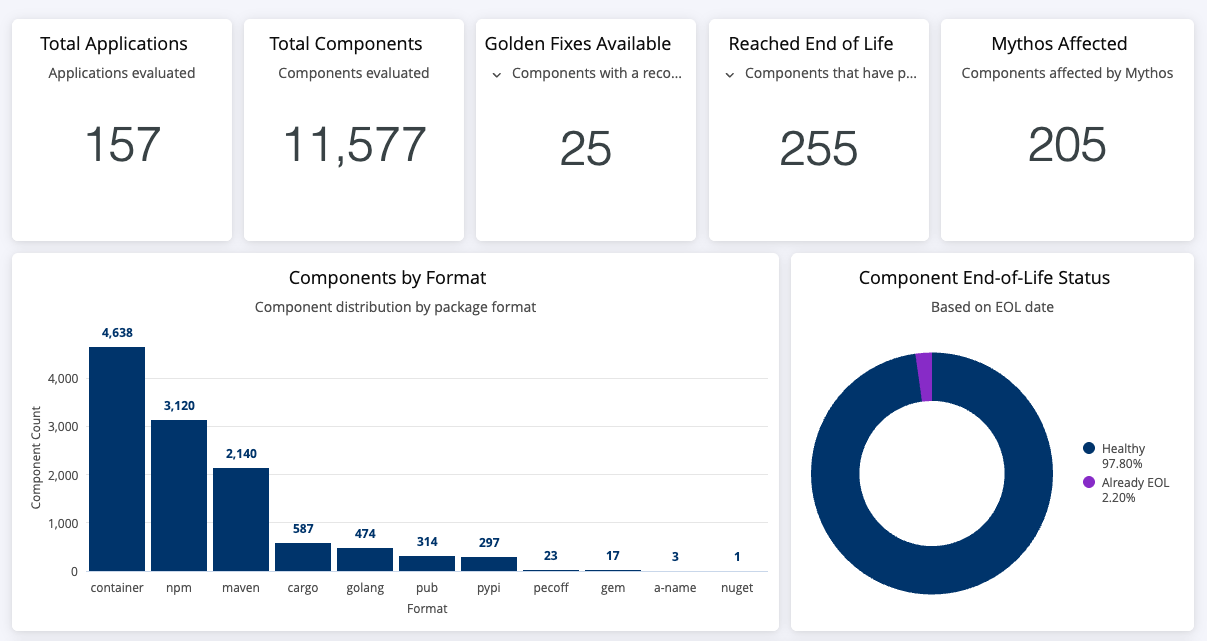 |
The Component Inventory also includes clearer Mythos Affected visibility, helping security and development teams identify components that may be impacted by privately disclosed vulnerabilities before a CVE identifier becomes available.
For full details, see the Mythos Readiness Enterprise Reporting dashboard help documentation.
Best Practices Dashboard Enhancements
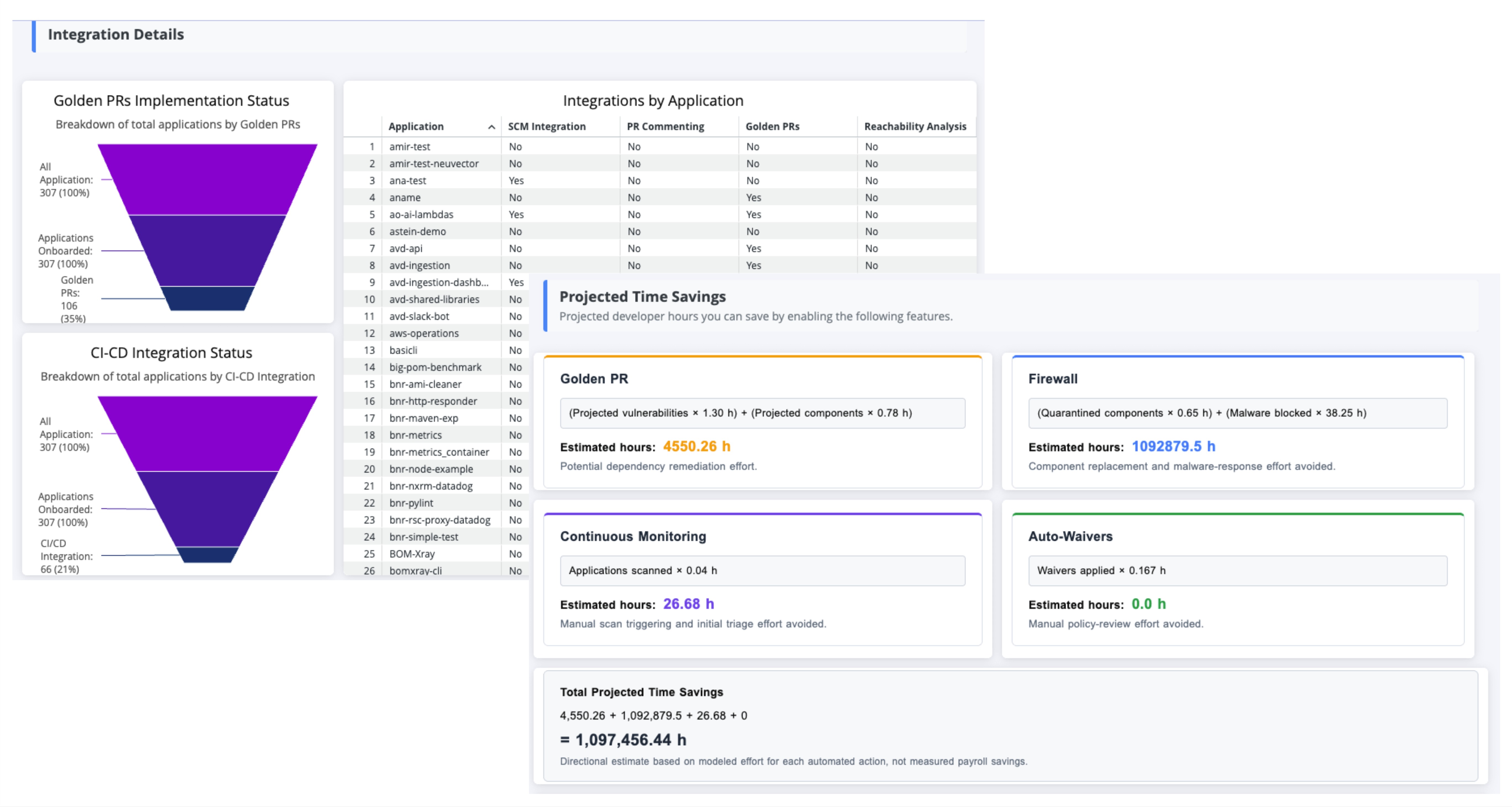
The Best Practices Enterprise Reporting dashboard now provides clearer insights into feature adoption, integration coverage, scan activity, and projected time savings across your organization. Updated dashboard content and visualizations make it easier to identify gaps in Lifecycle usage, understand where key capabilities are enabled, and evaluate consistency across applications and development stages.
 |
For full details, see the Best Practices Enterprise Reporting Dashboard help documentation.
 Sonatype AI Developer
This release includes the following changes for Sonatype AI Developer:
AI Developer Now Available to All Self-Hosted Lifecycle Customers via Simple Opt-In
Self-hosted Sonatype Lifecycle customers can now activate Sonatype AI Developer for their entire organization directly from the product UI, without updating their license or contacting Sonatype Support. Any authenticated Lifecycle user can opt in from the AI Developer landing page, giving all users in the organization immediate access and making it easier for teams to evaluate AI Developer before making a broader commitment.
This organization-wide opt-in removes the licensing process previously required to access AI Developer while maintaining visibility into adoption through usage telemetry. Organizations whose licenses already include AI Developer can continue using it without any changes.
Note
All current Sonatype Lifecycle customers are entitled to a free allocation of credits for AI Developer.
Upgrade to the latest version of Lifecycle (Version 207 or later) to claim your credits and start bringing trusted open source intelligence and policy-aware guidance into your AI-assisted development workflow.
When the AI Developer pop-up appears, review and accept the terms, then select Agree and Continue to enable AI Developer. SaaS customers are already on the latest release and can skip the upgrade step.
 Sonatype Developer
This release does not include any Sonatype Developer-specific changes.
 SBOM Manager
This release does not include any Sonatype SBOM Manager-specific changes.
 Sonatype Repository Firewall
This release does not include any Repository Firewall-specific changes.
Bug Fixes
Jira Issue | Description |
|---|---|
FIRE-792 | PyPI components evaluated through the Firewall Evaluation API now each maintain their own quarantine record, so all quarantined components remain visible in the quarantined components list until explicitly released. |
FIRE-517 | Policy Compliant Component Selection (PCCS) now correctly filters PyPI package versions that violate time-based Firewall policies from the simple index on the first request, preventing pip from attempting to download quarantined versions. |
FIRE-513 | Firewall dashboard historical charts now populate correctly for all date ranges when running on PostgreSQL deployments, with the metrics consolidation jobs completing successfully each scheduled cycle. |
CLM-44515 | Advanced search queries with leading wildcards return an HTTP 500 error response for the affected request without causing the server to shut down. |
CLM-43920 | GitHub pull request comments are now posted successfully even when evaluations contain large numbers of policy violations, with oversized content trimmed to fit provider limits and a link to the full report included rather than the comment being silently dropped. |
CLM-43732 | Container scans of Docker images with Python dependencies now resolve each installed wheel to its single platform-specific variant, eliminating duplicate vulnerability findings that previously appeared for every possible platform combination. |
CLM-42178 | npm package aliasing in |
CLM-41689 | Authenticated usernames in |
CLM-41469 | Windows IQ Server startup on Windows correctly loads JVM options from the |
CLM-40845 | Audit log responses from the |
CLM-40143 | Existing user tokens stored in the legacy Argon2id format will be automatically rehashed to the new format upon the next successful authentication; tokens already in use will continue to work without interruption, but this migration is irreversible. User token authentication now completes significantly faster under high request volumes, eliminating the latency spikes previously experienced during periods of heavy API traffic. |
CLM-39953 | Dashboard CSV exports for violations, components, applications, waivers, and waiver requests now stream results incrementally rather than loading the entire dataset into memory, preventing server outages when exporting data at large scale. |
CLM-38213 | Container image scans now report accurate policy violations for all Lifecycle product licenses, without requiring a Firewall license to detect vulnerable components. |
CLM-37981 | Advanced Search CSV export completes successfully when IQ Server is accessed through reverse proxies that use HTTP/1.0, including nginx environments with default proxy settings. |
CLM-37908 | "Younger than N days" age-based policy constraints now evaluate strictly, so components cataloged exactly N days ago correctly pass without triggering a violation. |
CLM-37109 | Pull request comments posted to Bitbucket are now trimmed to fit within Bitbucket's character limit, displaying the first 10 components and a link to the full report rather than failing silently when scan results exceed the maximum allowed size. |
CLM-36307 | SPDX SBOM scans containing |
CLM-34834 | Source control evaluations complete successfully when SSH operations are re-enabled on applications that were originally imported with SSH disabled. |
CLM-34561 | Invalid or unparseable SBOM items within scanned archives are now skipped individually rather than aborting the entire scan. Log output from third-party scan processing no longer floods |
CLM-33982 | CycloneDX SBOM scans now emit a warning-level log message when a component contains an invalid or malformed package URL, making it visible in standard CLI output rather than silently omitting the component from the report. |
CLM-33964 | Advanced Search completes successfully for users with access to large numbers of applications or organizations, eliminating the "too many clauses" error that previously prevented searches even when organization or application criteria were specified. |
CLM-25312 | Violation details in older evaluation reports now display a clear error message instead of remaining indefinitely in a "Loading..." state when violation identifiers are unavailable. |
Known Issues & Upgrade Guidance
This section capture known issues in the 207 release as well as upgrade guidance.
Resolved Known Issues
Impacted Versions(s) | Version in which Issue is Resolved | Issue Description |
|---|---|---|
207 | 207.1 | After upgrading an instance with an existing embedded H2 database to version 207, application scans can fail during policy evaluation because the migrated H2 schema can retain an incompatible reference to This issue does not affect fresh version 207 installations that use a new H2 database. |
207 | 207.1 | Sonatype is aware of an issue impacting Sonatype Lifecycle users who use SAML single sign-on (SSO) after upgrading to release 207 (1.207.0-01). During service provider (SP)-initiated SAML authentication, the |
Additional Upgrade Guidance
The IQ 207 release includes a change to SAML response-signature validation that may require action when upgrading from IQ 206:
If your identity provider signs the SAML assertion but not the outer SAML response, SAML SSO may fail after upgrading to IQ 207 when Validate Response Signature is enabled or left at its default. This is expected behavior and to continue using assertion-only signing, set Validate Response Signature to False and leave Validate Assertion Signature enabled. Alternatively, configure your identity provider to sign both the response and assertion.
Coming Soon
NeuVector-based Sonatype Container Security Sunset September 30, 2026
NeuVector-based Sonatype Container Security has reached the end of its Extended Maintenance period and will be sunset as of September 30, 2026. To continue receiving the latest container security capabilities, transition to Advanced Container Scanning (Sonatype Scanner Mode), which provides broader coverage, enhanced detection capabilities, and continued product innovation.