SBOM Continuous Monitoring
Vulnerability and policy violations for an SBOM remain static after the initial analysis performed when importing SBOMs. Continuous Monitoring automatically checks SBOM versions of an application for new violations on a nightly basis. Use this feature to alert you as to when your SBOMs have newly discovered vulnerabilities.
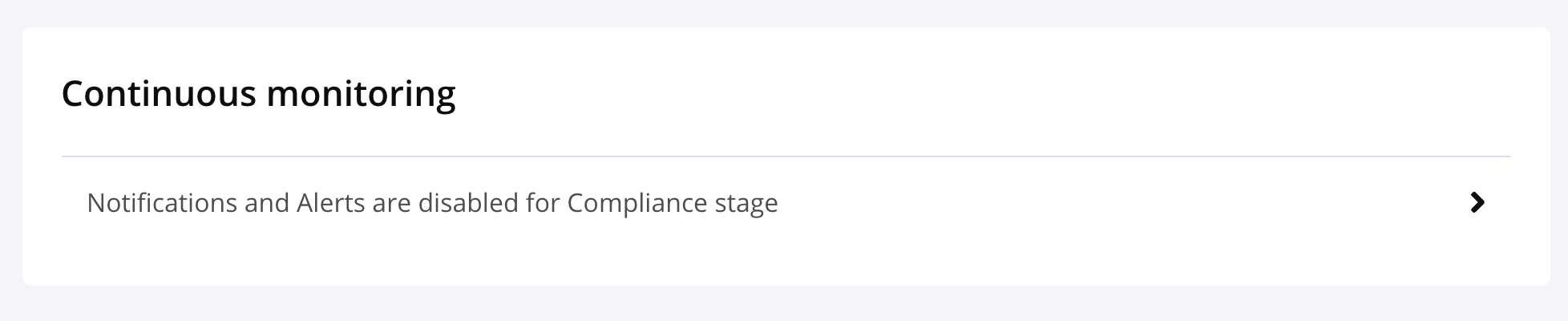
Continuous Monitoring Behavior
Continuous Monitoring for SBOM Manager uses the Compliance stage and functions independently from Lifecycle's monitoring configuration.
Administrators need to enable Continuous Monitoring before the SBOM Manager reports newly discovered violations.
Operating Model:
Monitors SBOM versions (not limited to the latest version).
Uses an evaluation queue to process SBOM evaluations asynchronously.
Evaluations can be distributed across multiple instances.
Monitoring Scope
By default, continuous monitoring evaluates all SBOM versions for an application.
You can restrict which versions are evaluated by configuring a version evaluation window.
Evaluation Queue Configuration
Continuous monitoring uses an evaluation queue to process SBOM evaluations asynchronously.
Configuration Properties
Property | Description | Default Value |
|---|---|---|
| Enables the evaluation queue producer and consumer | true |
| Interval at which the producer runs | 600000 (10 minutes) |
| Maximum number of evaluations queued by the producer | 1000 |
| Expected duration of a monitoring cycle | 86400000 (24 hours) |
| Restarts the cycle if it exceeds the expected duration | false |
| Number of threads used to process evaluations | 1 |
| Interval at which the consumer runs | 300000 (5 minutes) |
| Maximum number of evaluations processed per cycle | 30 |
| Time before queued evaluations are released for reprocessing | 6000000 (100 minutes) |
| Starts the monitoring cycle at the configured policy monitoring hour instead of immediately | true |
Note
If a monitoring cycle does not complete within the expected duration, processing continues until all evaluations are completed unless resetCycleTimeout is enabled.
cURL example
Use the Configuration REST API to update evaluation queue settings.
curl -u admin:admin123 \
  -X PUT "http://localhost:8070/api/v2/config" \
  -H "Content-Type: application/json" \
  -d '{
    "evaluationQueueConfig": {
      "enabled": true,
      "producerPeriodInMilliseconds": 600000,
      "producerMaxQueuedRows": 1000,
      "cyclePeriodInMilliseconds": 86400000,
      "resetCycleTimeout": false,
      "consumerThreadsPerTenant": 1,
      "consumerPeriodInMilliseconds": 300000,
      "consumerMaxQueuedRows": 30,
      "consumerRowExpirationInMilliseconds": 6000000,
      "startTimeDelayEnabled": true
    }
  }'
Version Evaluation Window
By default, continuous monitoring evaluates all SBOM versions.
You can restrict the evaluated versions by configuring a version evaluation window.
A version evaluation window allows you to limit evaluations by number of versions or by age.
Configuration Properties
Property | Description | Required |
|---|---|---|
| Context where the window is applied | Yes |
| Maximum number of versions to evaluate starting from most recent | Optional* |
| Maximum age of versions to evaluate | Optional* |
Note
Either maxVersions or maxAgeInDays must be set to define the evaluation window.
cURL example
Use the API to configure a version evaluation window.
curl -u admin:admin123 \
  -X PUT "http://localhost:8070/api/v2/versionEvaluationWindow/organization/ROOT_ORGANIZATION_ID" \
  -H "Content-Type: application/json" \
  -d '{
    "contextId": "compliance",
    "maxVersions": 5,
    "maxAgeInDays": 90
  }'
Tuning Recommendations
Continuous monitoring is configured with conservative defaults. If monitoring cycles do not complete within the expected duration, you can adjust configuration to improve throughput.
A monitoring cycle that does not complete within the configured cyclePeriodInMilliseconds may indicate that the current configuration or evaluation scope is too large.
To improve completion time, you can:
Increase evaluation throughput by adjusting
consumerThreadsPerTenantorconsumerMaxQueuedRowsReduce evaluation scope by limiting the number of versions evaluated using a version evaluation window
Key Parameters
The following parameters have the most impact on evaluation throughput:
consumerThreadsPerTenant: Controls the number of parallel evaluation threadsconsumerMaxQueuedRows: Controls how many evaluations are processed per cycle
Resource Impact per Consumer Thread
Resource | Approximate Impact |
|---|---|
CPU | <1% per core during evaluations |
Memory | ~0.5 to 1 GB additional heap |
Note
Each instance runs its own consumer threads. Increasing thread count increases overall resource usage.
Enabling Continuous Monitoring
Administrators may enable Continuous Monitoring from the Organizations view. We recommend setting the configuration at the Root Organization, however, this setting may be enabled at any level of the organization hierarchy.
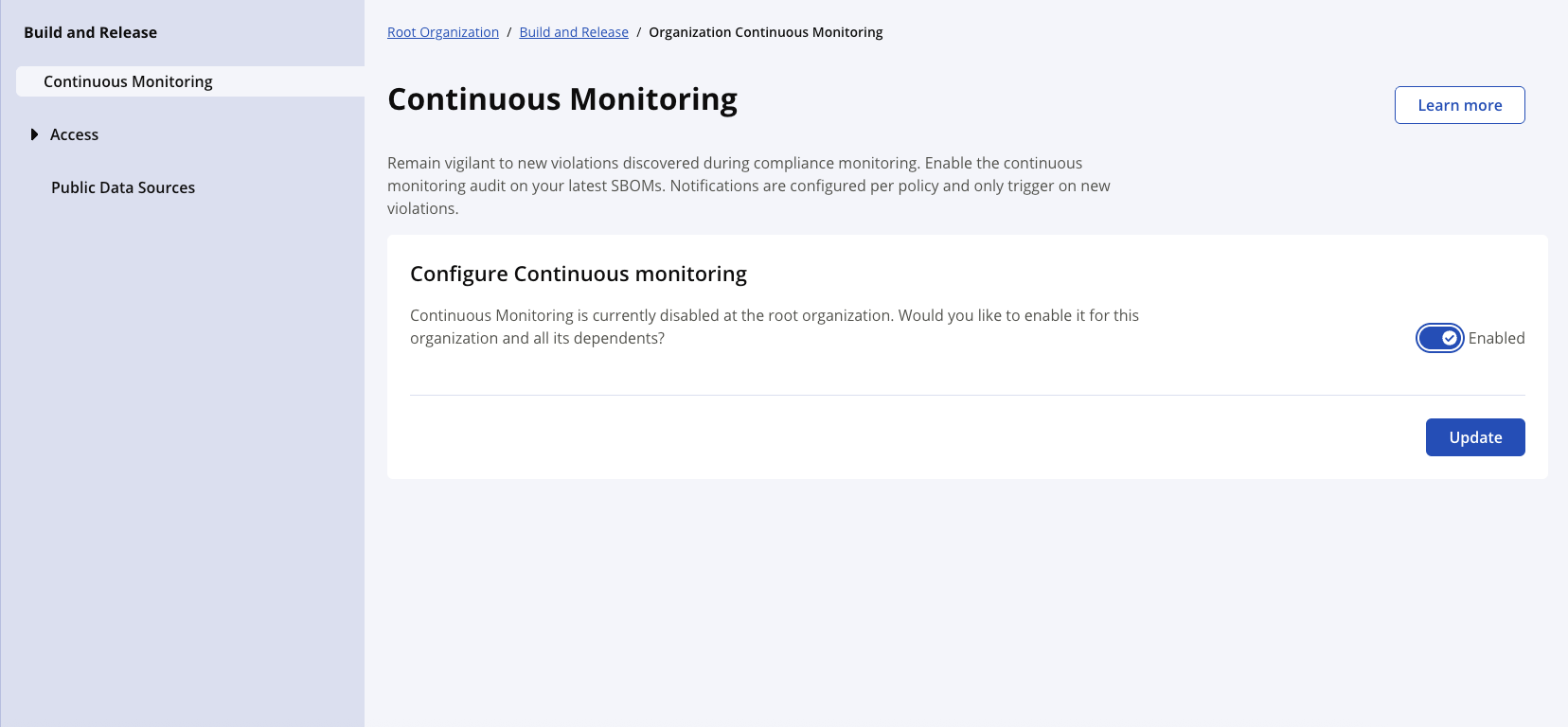
Navigate to the Organizations view
From the center view, select the Continuous monitoring configuration
Toggle the button from Disabled to Enabled
Select Update
Scheduling Continuous Monitoring
Continuous Monitoring starts at midnight for the hosting system. You can change the start time through the Configuration REST API.