Size XL - Sonatype Nexus Repository - AWS Cloud-Native Reference Architecture
This Nexus Repository extra-large reference architecture describes the minimum requirements for an enterprise-scale high-availability Nexus Repository cluster in AWS with a baseline request load of 15,000 requests per second (900,000 requests per minute). It has been validated to support this volume in a steady state and to handle spikes of 50,000 requests per second without failing.
This architecture is designed for global enterprises and very large development organizations that require extreme-scale throughput, advanced high availability, and strong operational resilience.
Infrastructure Specifications
This Nexus Repository reference architecture defines an enterprise-scale clustered Nexus Repository deployment supported by shared infrastructure services. The architecture includes the following layers:
Compute Layer – Nexus Repository clustered application runtime
Database Layer – Highly available PostgreSQL database
Storage Layer – Optimized shared object storage for blob data
Network Layer – Load balancing and cluster connectivity
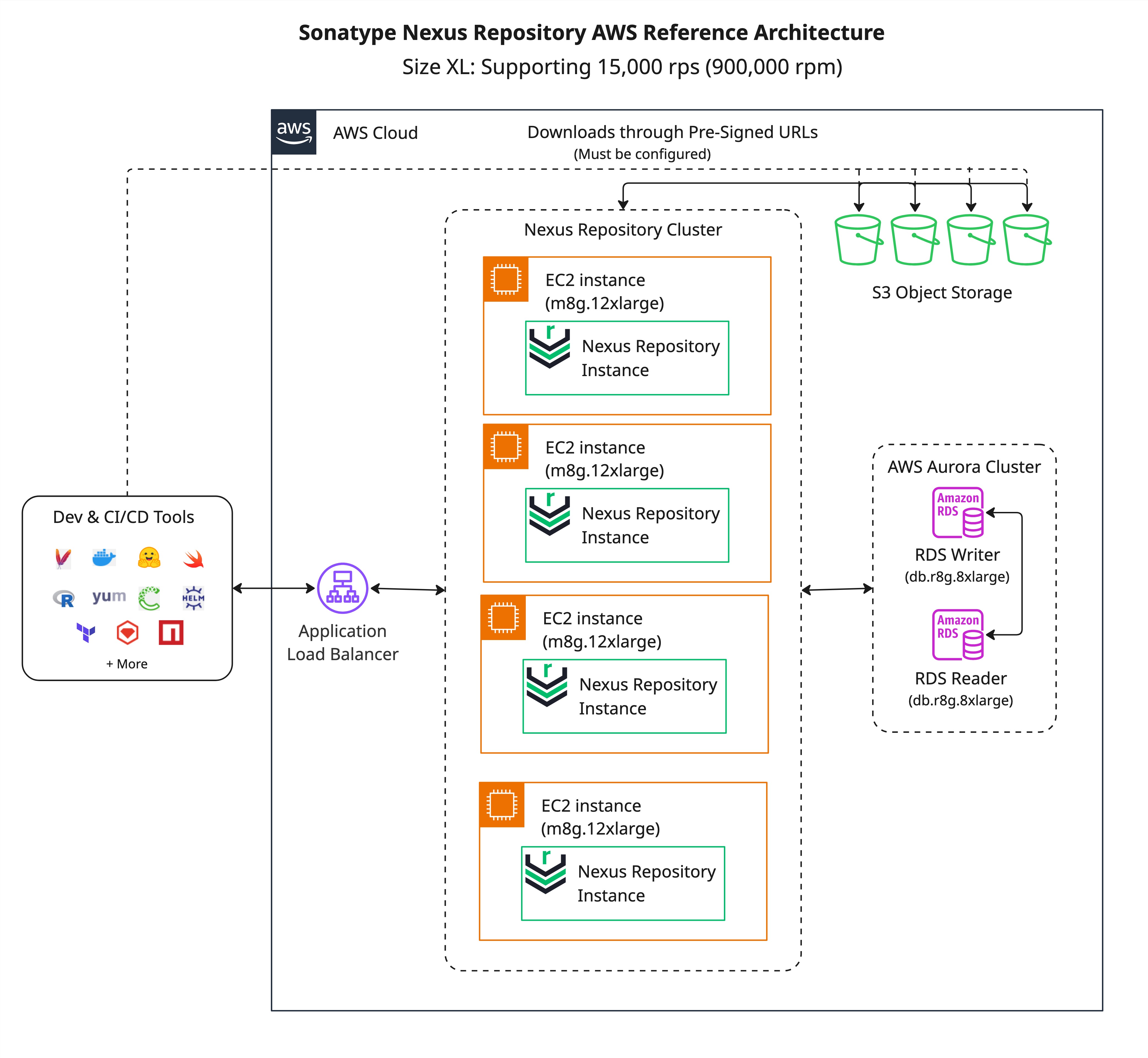
Compute Layer (Nexus Repository)
The compute layer comprises the Nexus Repository application cluster, which processes repository requests across multiple high-capacity nodes.
This layer meets the following specifications:
Four Nexus Repository nodes:
48 vCPU per node
192 GiB RAM per node
Cluster capacity:
192 total vCPU
768 GiB total RAM across the cluster
JVM configuration (per node):
Xms=96G
Xmx=96G
MaxDirectMemorySize=48G
Example AWS instance types:
m8g.12xlarge
m7g.12xlarge
Each node participates in the Nexus Repository cluster and connects to shared database and storage services. Local storage is used for operational data and temporary files.
Recommended local storage configuration per node:
Local NVMe SSD
Approximately 500 GB
Minimum 3000 IOPS
Recommended network configuration per node:
≥25 Gbps network bandwidth per node
Higher bandwidth if artifact downloads are not offloaded through object storage
Database Layer (PostgreSQL HA)
This architecture uses a highly available PostgreSQL database cluster. This configuration removes the database as a single point of failure and provides automatic failover capability.
This layer meets the following specifications:
PostgreSQL high-availability deployment
One primary writer node
One reader node for failover
Example AWS deployment:
AWS RDS PostgreSQL or Aurora PostgreSQL
Size: db.r8g.8xlarge
32 vCPU
128 GiB RAM
Database connection pool sizing:
~800–1,200 connections per node
~3,200–4,800 total connections across cluster
Network and Security
This architecture requires an Application Load Balancer (ALB) to distribute repository traffic across the cluster nodes.
Apply standard network security practices, including the following:
Restrict inbound access to the repository service ports
Secure administrative access to the host instance
Isolate repository infrastructure within a controlled network environment
Limitations
This architecture is designed for a single-region deployment and does not provide multi-region failover.
You must enable rolling upgrades on each Nexus Repository node in order to upgrade your Nexus Repository version without downtime.
Enterprise-scale deployments require additional infrastructure tuning, including increased database and object storage connection pools.
Deploying this Architecture
You can quickly deploy this reference architecture using Sonatype's Nexus Repository Terraform configuration for an AWS deployments. This automates the creation and configuration of all required AWS resources, including networking, compute, storage, and security components.
For full deployment details, see the README that accompanies the provided Terraform.