Size XS - Sonatype IQ - AWS Cloud-Native Reference Architecture
This Sonatype IQ Server extra-small reference architecture describes the minimum supported infrastructure specifications for deploying a single IQ Server instance in AWS using cloud-native services. It supports environments with fewer than 500 applications and an expected throughput of approximately 80–120 evaluations per hour, or approximately 1,920–2,880 evaluations per day.
This reference architecture represents the smallest supported infrastructure footprint for running IQ Server. It is appropriate for evaluation environments, proof-of-concept deployments, and small teams with light evaluation volume. It is not designed for high availability and is not recommended for production environments that require automatic failover or continuous availability.
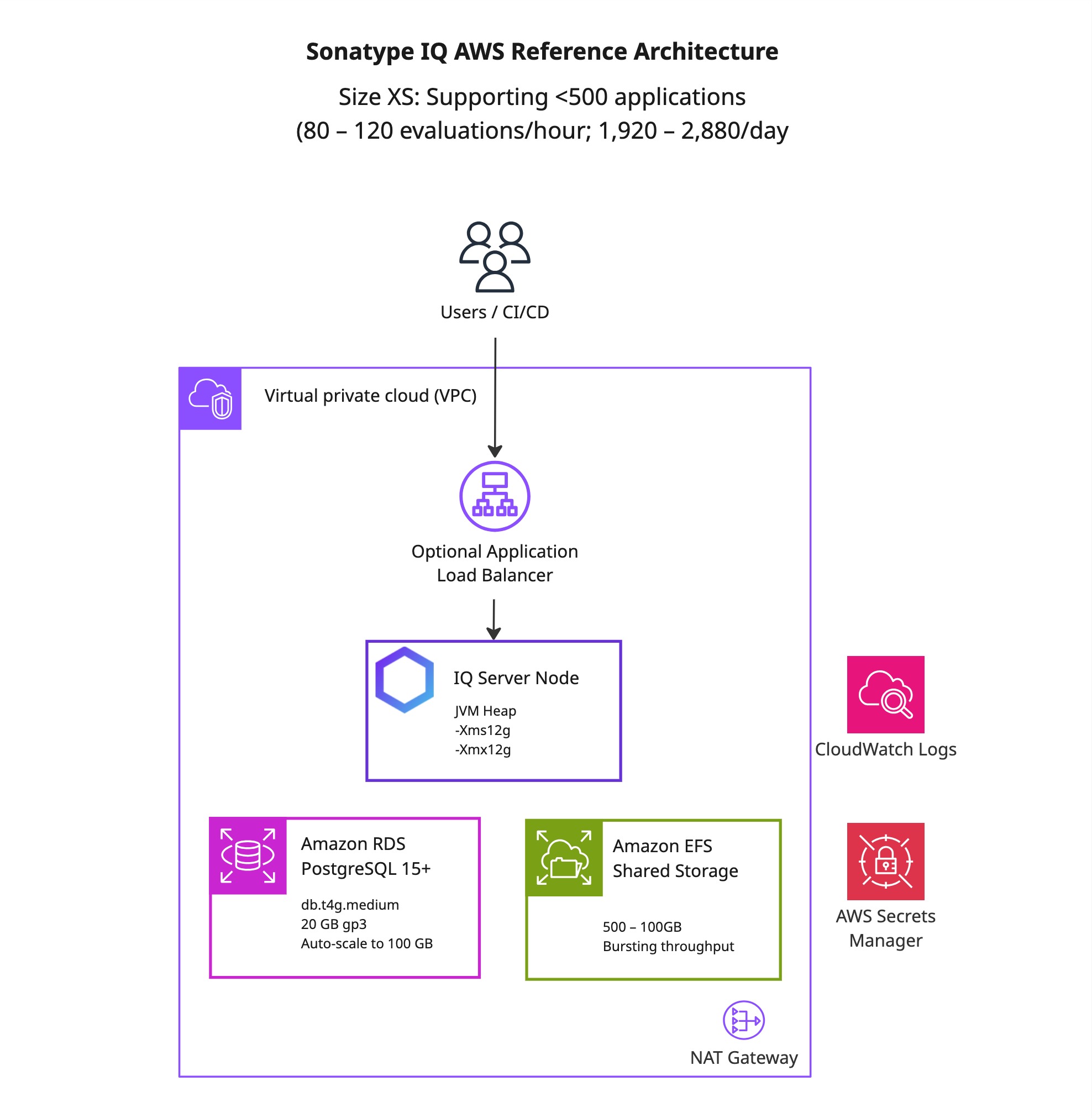
Infrastructure Specifications
The architecture includes the following layers:
Compute Layer – IQ Server application runtime
Database Layer – PostgreSQL metadata database
Storage Layer – Shared file storage for IQ Server data
Network Layer – Connectivity, access control, and optional load balancing
Compute Layer (IQ Server)
The compute layer hosts the IQ Server application and processes application evaluations, policy evaluations, reports, and related user activity.
This layer meets the following specifications:
Single IQ Server node:
2 vCPU
16 GB RAM
JVM configuration:
-Xms12g-Xmx12g
Example AWS instance types:
r6g.largefor ARM-based deploymentsr5.largefor x86-based deployments
This architecture uses a single IQ Server node. Because it does not include multiple application nodes, it does not provide application-level high availability.
Database Layer (RDS PostgreSQL)
Amazon RDS provides high-performance database operations and fast storage with automatic scaling.
This layer meets the following specifications:
Service: Amazon RDS for PostgreSQL 15 or later
Instance class:
db.t4g.mediumDatabase resources:
2 vCPU
4 GB RAM
Storage:
20 GB gp3
Auto-scaling up to 100 GB
Multi-AZ optional; recommended for production
7-day automated retention for backups
Storage Layer (Amazon EFS)
Amazon EFS provides persistent data storage and log aggregation. This layer meets the following specifications:
Service: Amazon EFS
Throughput mode: Bursting (appropriate for low-usage environments where evaluation activity is light/intermittent)
Estimated capacity: 50–100 GB
For cost optimization, use lifecycle policies to move infrequently accessed data / files older than 30 days to EFS Infrequent Access
Network and Security
Typical deployment patterns include the following:
Direct access to the IQ Server node
Optional Application Load Balancer in front of the IQ Server node
Private connectivity between IQ Server, PostgreSQL, and EFS
Apply standard network security practices, including the following:
Security Groups following least-privilege principle
NAT Gateway for outbound internet access
AWS Secrets Manager for credential management
CloudWatch for unified logging
Limitations
This architecture has the following limitations:
This architecture supports a single IQ instance only. It does not support a multi-instance high-availability deployment.
Increasing scan volume or concurrent evaluations beyond the recommended profile may lead to degraded performance.
While RDS can use Multi-AZ for database resilience, the application layer itself is not redundant.
This architecture is not intended for disaster recovery and does not provide cross-region failover.
Deploying this Architecture
You can quickly deploy this reference architecture using Sonatype's IQ Terraform configuration for AWS deployments. This automates the creation and configuration of all required AWS resources, including networking, compute, storage, and security components.
For full deployment details, see the README that accompanies the provided Terraform.