Size XL - Sonatype IQ - AWS Cloud-Native Reference Architecture
This Sonatype IQ Server extra-large reference architecture describes the recommended infrastructure specifications for deploying a large-scale high-availability IQ Server environment in AWS using cloud-native services. It supports environments with 20,000–80,000 onboarded applications and an expected throughput of approximately 405 evaluations per hour per node, or approximately 29,160–38,880 evaluations per day total.
This reference architecture is designed for enterprise-scale production environments that require maximum evaluation throughput, large onboarding capacity, resilient infrastructure services, and operational scalability.
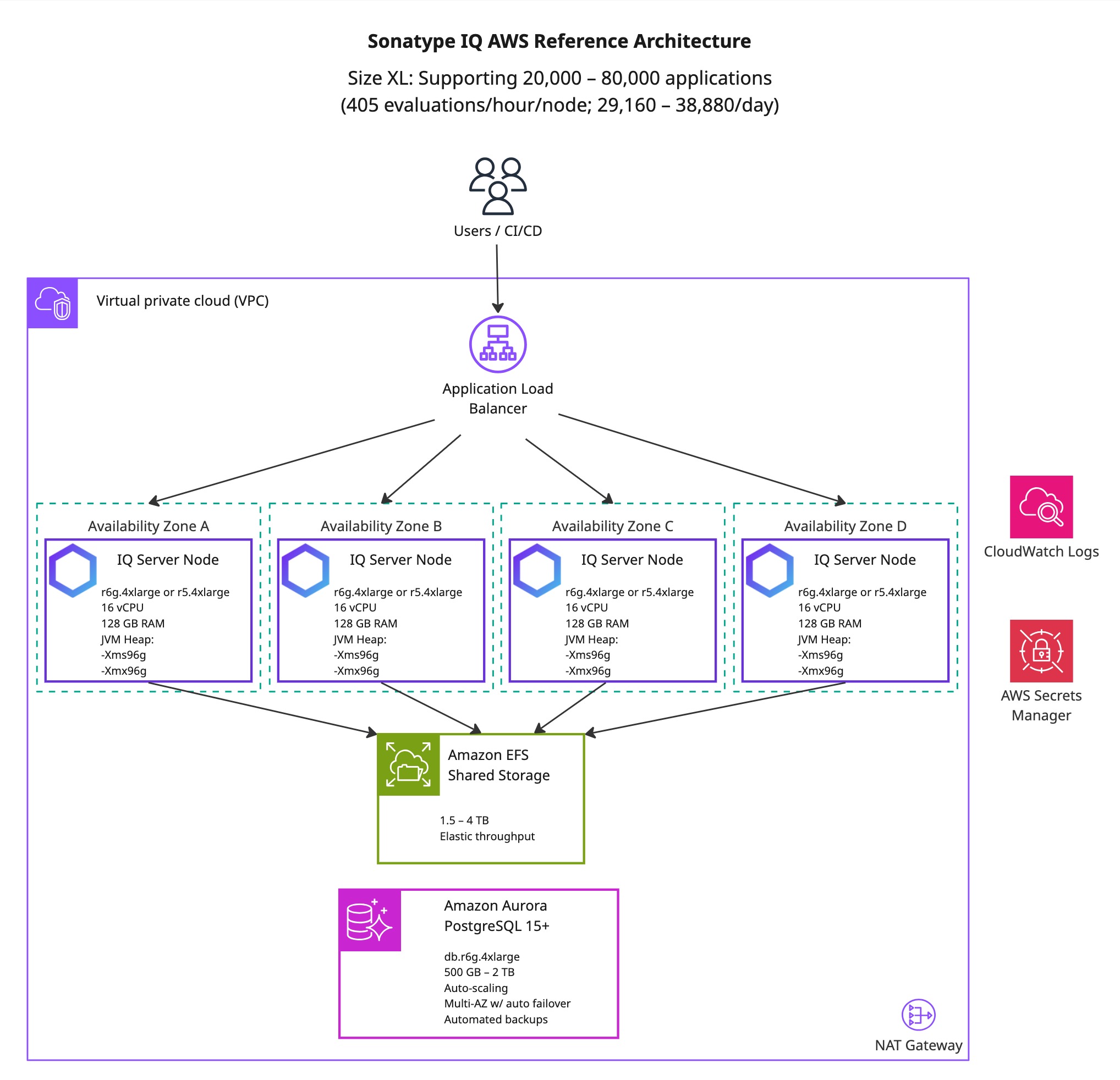
Infrastructure Specifications
This architecture includes the following layers:
Compute Layer – High-availability IQ Server application cluster
Database Layer – Aurora PostgreSQL metadata database
Storage Layer – Shared file storage for IQ Server data
Network Layer – Load balancing, connectivity, and security controls
Compute Layer (IQ Server)
The compute layer hosts the IQ Server application cluster and processes application evaluations, policy evaluations, reports, and related user activity.
This layer meets the following specifications:
Four IQ Server nodes:
16 vCPU per node
128 GB RAM per node
JVM configuration per node:
-Xms96g-Xmx96g
Example AWS instance types:
r6g.4xlargefor ARM-based deploymentsr5.4xlargefor x86-based deployments
This architecture uses four IQ Server nodes deployed behind a load balancer to provide application-level high availability, increased aggregate evaluation throughput, and operational headroom for enterprise-scale workloads.
Typical deployment patterns include the following:
Active-active IQ Server node configuration
Stateless application nodes connected to shared infrastructure services
Application Load Balancer distributing traffic across IQ Server nodes
Multi-AZ deployment for all application infrastructure
Database Layer (Aurora PostgreSQL)
The database layer stores IQ Server application metadata, policy data, configuration information, and operational state.
This layer meets the following specifications:
Service: Amazon Aurora PostgreSQL 15+
Instance class:
db.r6g.4xlargeDatabase resources:
16 vCPU
128 GB RAM
Storage: 500 GB–2 TB auto-scaling
Multi-AZ with automatic failover required
Automated backups enabled
Aurora PostgreSQL is required at this tier to support enterprise-scale workloads, resilient database operations, and automatic failover capabilities.
Storage Layer (Amazon EFS)
Amazon EFS provides shared persistent storage for IQ Server application data, reports, logs, and scan-related content across all IQ Server nodes.
This layer meets the following specifications:
Service: Amazon EFS
Througput mode: Elastic
Estimated capacity: 1.5 TB–4 TB
Shared storage mounted across all IQ Server nodes
For cost optimization, use lifecycle policies to move infrequently accessed data or files older than 30 days to EFS Infrequent Access
Elastic throughput is required for this architecture because large-scale concurrent evaluation workloads and reporting operations may generate sustained storage throughput demands across multiple nodes.
Network and Security
This architecture uses load-balanced high-availability connectivity across multiple IQ Server nodes.
Typical deployment patterns include the following:
Application Load Balancer in front of IQ Server nodes
Private connectivity between IQ Server, Aurora PostgreSQL, and EFS
IQ Server nodes distributed across multiple Availability Zones
Private subnets for database and storage infrastructure
Apply standard network security practices, including the following:
Security Groups following least-privilege principle
NAT Gateway for outbound internet access
AWS Secrets Manager for credential management
CloudWatch for centralized logging and monitoring
TLS encryption for inbound and internal service communication
Restricted administrative access through bastion hosts or approved management services
Monitoring and alerting for infrastructure scaling, storage throughput, and database performance
Limitations
This architecture has the following limitations:
This architecture provides application-level high availability but does not provide cross-region disaster recovery.
Large evaluation spikes or rapid onboarding growth beyond the validated profile may require additional infrastructure tuning or architectural review.
Shared storage throughput and database performance remain critical scaling dependencies and should be continuously monitored.
Operational complexity is significantly higher than smaller profiles because this architecture requires coordinated management of multiple IQ Server nodes, load balancing, shared storage, Aurora PostgreSQL, and Multi-AZ infrastructure services.
Deploying this Architecture
You can quickly deploy this reference architecture using Sonatype's IQ Terraform configuration for AWS deployments. This automates the creation and configuration of all required AWS resources, including networking, compute, storage, and security components.
For full deployment details, see the README that accompanies the provided Terraform.